Ask a collector which countries define fine watchmaking and you will hear two answers: Switzerland — and Germany. German watchmaking earned its reputation differently. Not with glitter or marketing spend, but with engineering discipline, legibility and honest design. This guide covers what actually makes a watch German, the eleven brands that built that reputation, roughly what they cost, and where RMS Zeitmeister fits into the tradition.
Why Germany matters in watchmaking
German watchmaking grew out of three regions, each with a distinct character.
Glashütte, a Saxon village of barely seven thousand people, became the heart of German haute horlogerie after Ferdinand Adolph Lange opened his workshop there in 1845. Watchmaking in Glashütte survived war, expropriation and four decades behind the Iron Curtain, then returned with remarkable speed after reunification. Today a watch may carry the Glashütte name only if a substantial share of its value is created in the town.
The Black Forest, around Schramberg and Villingen, built Germany's mass-market clock and watch industry in the nineteenth century. At its peak it was the largest watch factory operation in the world by volume.
Pforzheim, Germany's jewellery city, produced the pilot-watch makers whose oversized Flieger dials remain among the most imitated designs in all of watchmaking.
Layered across all three is the Bauhaus movement, whose “form follows function” philosophy shaped the clean, purposeful look German watches are loved for today.
What makes a watch feel German
- Clarity first — the dial should be readable in a single glance, day or night.
- Function over ornament — every element earns its place; nothing is decoration for decoration's sake.
- Precision engineering — tight tolerances, robust cases, movements built to run for decades.
- Distinctive finishing — three-quarter plates, screwed gold chatons and Glashütte ribbing instead of Geneva stripes.
- Quiet confidence — German watches rarely shout; they let the craftsmanship speak.
The 11 most important German watch brands
The prices below are indicative starting points that move with the market. Treat them as orientation, not quotations.
1. A. Lange & Söhne — founded 1845, Glashütte
Germany's most prestigious watchmaker and, by most accounts, one of the finest anywhere. Ferdinand Adolph Lange founded the workshop that turned a poor mining village into a watchmaking town. The company was expropriated after the Second World War and vanished for four decades, until his great-grandson Walter Lange relaunched it in 1990. The Lange 1, with its off-centre dial and outsize date, arrived in 1994 and became an instant modern classic. Roughly €20,000 and upwards.
2. Glashütte Original — Glashütte, heir to the town's tradition since 1845
The modern company emerged in the 1990s from the state-owned combine that had absorbed Glashütte's historic workshops under the GDR. It is unusually vertically integrated, producing the great majority of its components in house, including its own dials at a dedicated factory in Pforzheim. Best known for the Senator and PanoMaticLunar families. Roughly €6,000 to €40,000.
3. Nomos Glashütte — founded 1990, Glashütte
Founded the year the Berlin Wall came down, Nomos did something few thought possible: it built Bauhaus minimalism into a commercially successful watch house with genuinely in-house movements. The Tangente, with its slim case and painted numerals, is one of the most recognisable dials in modern watchmaking. Nomos is the entry point most enthusiasts recommend for German design. Roughly €1,500 to €4,000.
4. Junghans — founded 1861, Schramberg
Erhard Junghans began with clock parts and built what became, for a time, the largest watch factory in the world. Its enduring contribution is the Max Bill collection, based on designs by the Bauhaus-trained artist and architect of the same name. Few watches express “form follows function” more purely. Roughly €700 to €2,500.
5. Sinn Spezialuhren — founded 1961, Frankfurt
Founded by pilot and flight instructor Helmut Sinn, this is Germany's engineering-first tool-watch house. Sinn is known for genuine technical innovation rather than styling: tegimented steel that resists scratching, dehumidifying capsules that keep the case dry, and oil-filled diving watches. Favoured by pilots, divers and specialist units. Roughly €1,000 to €4,000.
6. MeisterSinger — founded 2001, Münster
The youngest brand on this list and the most conceptually distinctive. Nearly every MeisterSinger has a single hand, reading the time to roughly five minutes. It sounds like a gimmick until you wear one; the argument is that most of us do not actually need the second hand, and that a calmer dial changes your relationship with time. Roughly €1,000 to €2,500.
7. Union Glashütte — founded 1893, Glashütte
Founded by Johannes Dürrstein and re-established in 1996, Union occupies the accessible end of genuine Glashütte watchmaking. It offers mechanical watches made in the town at a fraction of what its more famous neighbours charge. Roughly €1,500 to €3,500.
8. Mühle-Glashütte — founded 1869, Glashütte
The Mühle family made precision measuring instruments for the Glashütte watch industry for well over a century before producing wristwatches under their own name in the 1990s. That heritage shows: Mühle's strongest work is nautical, and the company still supplies instruments to shipyards. Roughly €1,000 to €3,000.
9. Laco — founded 1925, Pforzheim
Laco was one of only five manufacturers authorised to produce the original B-Uhr observation watches for German aviators in the 1940s. Those oversized dials with the triangle at twelve became the template for every pilot watch made since. Laco still builds them, in both faithful and modernised form. Roughly €400 to €2,000.
10. Stowa — founded 1927, Pforzheim
Another of the original five B-Uhr makers, Stowa has a second string: the Antea, a Bauhaus dress watch whose design language runs directly parallel to Nomos. Small, family-run and sold largely direct, which is why the value proposition is unusually strong. Roughly €600 to €2,000.
11. Damasko — founded 1994, near Regensburg
An engineering firm before it was a watch brand, Damasko developed its own ice-hardened steel and later its own movements and escapement components. The watches look understated and are exceptionally hard-wearing. A favourite of people who research obsessively before buying. Roughly €1,000 to €3,000.
Honourable mentions belong to Hanhart, the Black Forest chronograph specialist founded in 1882, and Archimede, whose Pforzheim case factory supplies much of the German industry.
German versus Swiss: how do they really compare?
At the very top, the comparison is a genuine contest. A. Lange & Söhne is routinely placed alongside the finest Swiss houses, and in movement finishing it is frequently ranked above most of them. Below that tier the two traditions diverge in emphasis rather than quality. Swiss brands tend to invest in heritage, marketing and resale value; German brands tend to invest in the object itself. The common verdict among collectors is that German watches deliver more substance per euro, while Swiss watches hold their value better on the secondary market.
There is also a visual divide. Swiss design leans towards richness and presence; German design leans towards restraint and legibility. Neither is correct. It depends on whether you want your watch to be noticed or to be useful.
RMS Zeitmeister: German design, made accessible
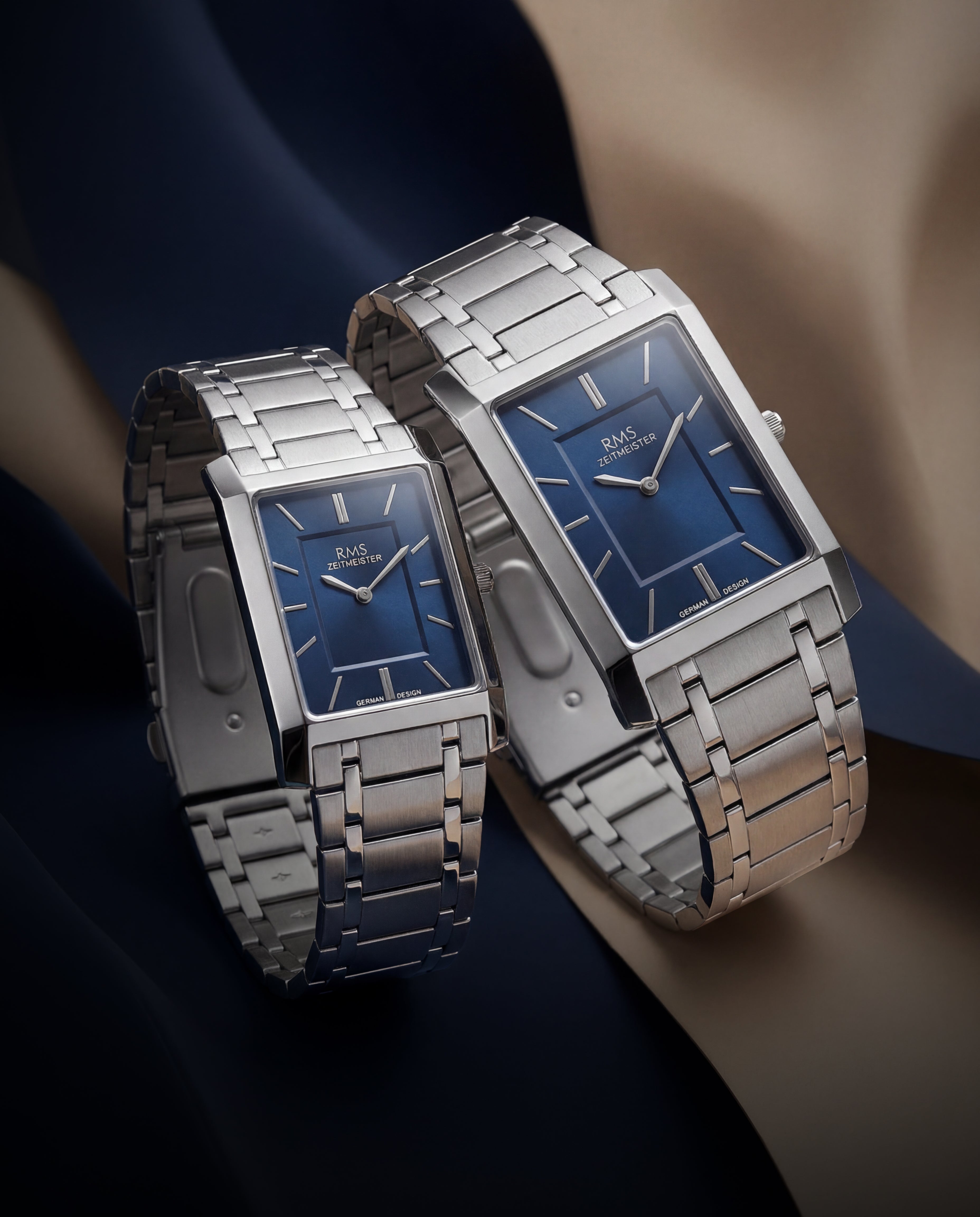
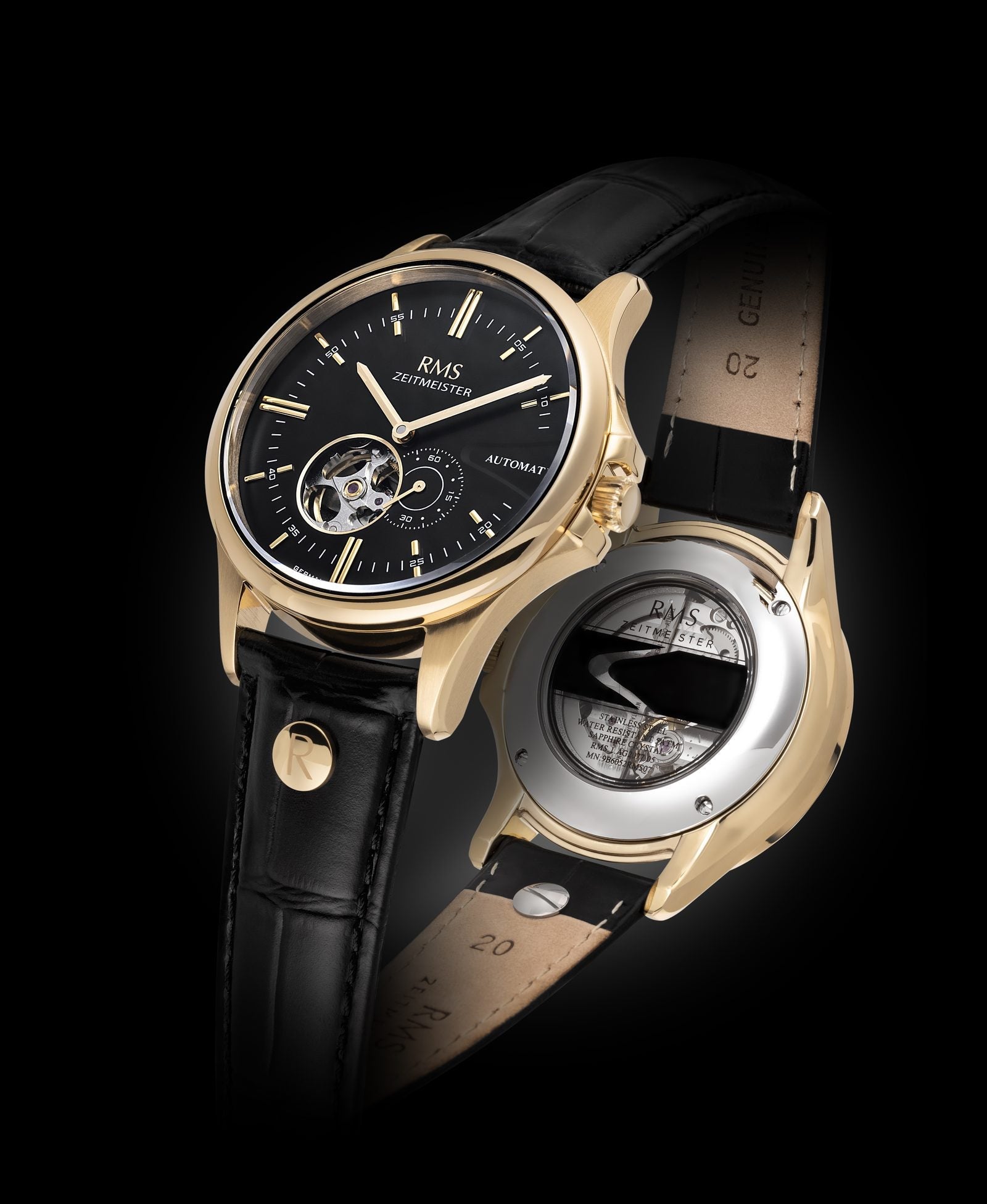
The brands above are magnificent and, for most people, out of reach. RMS Zeitmeister exists to bring the same design language — clarity, precision, quiet elegance — to a price point that does not require saving for a year. The name states the intent: Zeitmeister, master of time.
Our collections are a tour of Germany's cities and their character: Bonn Elegance for refined dress watches, Berlin Active for dynamic everyday wear, Hamburg Prestige for the boardroom, Munich Harmony for minimalists, Stuttgart Precision with automatic movements for enthusiasts, Bremen Heritage for classical proportions and Bavaria Legacy for timeless steel.
Every RMS Zeitmeister watch ships with free delivery across Türkiye (free worldwide on orders over $300), six interest-free installments, an international warranty and free case-back name engraving.
How to choose a German-style watch
- Decide the occasion. Dress, business, sport or daily wear — this narrows the field faster than anything else.
- Pick your movement. Quartz for zero-maintenance precision, automatic for mechanical character.
- Match case size to your wrist. German design favours proportion; 38–42 mm suits most wrists.
- Choose dial and strap. Black, white or silver dials with leather for classic looks; coloured dials and steel bracelets for modern character.
- Check the essentials. Water resistance, warranty terms and installment options.
Frequently asked questions
What are German watches known for?
Engineering precision, Bauhaus-influenced clean design, outstanding legibility and long-term reliability. Distinctive movement architecture — three-quarter plates and Glashütte ribbing — also sets them apart visually from Swiss calibres.
Is German watchmaking as good as Swiss?
At the highest level, yes. Glashütte manufactures stand shoulder to shoulder with the finest Swiss houses, and German watches are widely regarded as offering more substance per euro. Swiss watches generally hold resale value better.
Which is the best-known German watch brand?
A. Lange & Söhne is the most prestigious. Junghans is the most historically widespread, and Nomos Glashütte is probably the best known among younger buyers.
What is the most affordable real German watch brand?
Among the traditional houses, Laco and Stowa start lowest, followed by Junghans. For German-designed watches at a genuinely accessible price, RMS Zeitmeister sits below all of them.
What does “Zeitmeister” mean?
It is German for “master of time” — the idea at the heart of the RMS Zeitmeister brand.
Why is Glashütte so important to German watchmaking?
Almost every major German mechanical watch brand either originates in Glashütte or traces its technical lineage there. The town has produced watches continuously since 1845, and German law protects the use of its name.
Where can I buy German-designed watches with installments?
At rmswatches.com: free shipping across Türkiye (free worldwide over $300), six interest-free installments and an international warranty on every model.
Discover the collections
Explore men's watches and women's watches designed in the German tradition — and find the timepiece that masters your time.